Monday, September 28, 2020

Christian Europe: the Age of Translated and Lost Rhetoric


After the fall of the Roman Empire in the fifth century, European Christendom followed as its successor. Without diving too deeply into the history of the takeover of Christianity in Europe, I am sure we are all aware of how the Church became the most powerful source of influence within Europe. The Church’s power came to control every aspect of public and private life, including what people should read.

In the shift between Roman and Church power, many rhetorical works were lost. Medieval Europeans were more familiar with Roman works than Greek works, creating a gap in knowledge that they could possess. Along with this, educated members of European society were suspicious of the Roman and Greek classics, which were associated with a pagan past.

Once the classic rhetorical works began to be found again, scholars would translate the work to present it to the public, creating a slow spread of emerging rhetoric in Christian Europe. However, later Medieval Scholars would only present components of work that they would deem “useful,” often meaning presentable to the Christian Church.  

With these ideas in mind, I would like to pose a question: how can we be sure rhetoric is being represented appropriately in our society when it has gone through so many radical changes through the centuries of its existence?

Although the rhetorical writings of the Greek and Roman philosophers have been continuously translated and analyzed as technology has advanced, I find it still hard to truly define rhetoric based out of an Ancient Greek or Roman standpoint because it is a culture that got lost in the Medieval Ages. Although Christian Europe did eventually move forward to accept works, especially with the help of St. Augustine, many libraries and information of rhetorical works were lost before that time, creating a lack of knowledge of what once was.

Even though we no longer live within the Middle Ages, the feelings towards rhetorical actions in that era are still present in today's society. For example, letter writing is still a quality that is treasured today since it is seen as a professional work of art. But how can we find letter writing so important when the Roman and Greek rhetoric encouraged the voice? The lost texts and cultures from the eras before the Middle Ages has created a distinct lack of judgement in the area of rhetoric. 

Rhetoric is an ever changing art, meaning it can be defined by more than one thought. However, I believe our society today would have a much more profound use for rhetoric if the Middle Ages had implemented the ideas that the Ancient Greeks and Romans had. Instead, their voices were removed, causing the creation of new forms of rhetoric while erasing the values of what once was true discourse.

Monday, September 21, 2020

Rhetoric is a LIAR... Sometimes

Bypassing the larger discussion of Aristotle's influence on western rhetoric (he's been in the limelight too long anyway and I'm tired of talking about him), let's instead think about Cicero for this post.

Cicero highlights the importance of planning and constructing the speech, especially pointing out how crucial it is to know your audience and be able to adapt the speech to them. He lists 5 cases a speaker might need to make based on their audience: the honorable, the astonishing, the low, the doubtful, and the obscure. 

Here's a short clip from an episode of It's Always Sunny in Philadelphia that I want to use to exemplify these cases and bring them into a modern context. In it, the character "Mac" attempts to suade his friends so they no longer believe in evolution. (Disclaimer: there is a bit of strong language)

https://www.youtube.com/watch?v=Zgk8UdV7GQ0

I think you can see 4 different cases of audience in this clip, most noticeably Dennis ("Mr. Reynolds") as the astonishing case because he vehemently disagrees with the argument Mac is presenting and Charlie as the obscure case because he doesn't really know what's going on. Frank (Danny Devito) would most likely be the low case because he doesn't seem to care about the argument while Dee (the blonde woman) struck me as the doubtful case because she wasn't as vocal about her disagreement as Dennis was but also definitely didn't agree with Mac. The only case left is the honorable one, where an audience is inclined to believe the orator right away. 

All four people included in Mac's audience have one thing in common, however, which is that they're all (somewhat) normal citizens in society; Mac even plays into this at the beginning of his argument when he assures them that he's "just a regular dude," which seems to convince at least Charlie of his credibility. I make this point because unlike Plato, Cicero believed that the general public was just as important to take into consideration as the people with power, no matter how "ignorant" they may appear to be.

Aside from these cases, this clip provides an example of when humor is used within an argument, which is something Cicero also talks about. Cicero states that humor is a way to solidify yourself as a superior orator/rhetorician, so long as you know when to use it. Cicero would definitely argue that Mac did NOT use humor correctly here--slapping a bold, red insult across the faces of people your opponents would find respectable is the same as committing rhetorical suicide in his eyes. 

It's interesting to think about how humor in rhetoric has evolved since ancient times--while Cicero would have disapproved of crude humor being used in an argument, Mac's friends certainly don't, and I think this sentiment is common in the US today. Mockery is used in arguments so much in present times that it often replaces actual criticism. Instead of saying that I think you might be reacting too impulsively to the actions of a person, I call you a snowflake. Instead of telling you that your way of thinking is dated and problematic, I call you a boomer. We've created insults to take the place of full-length arguments (not that this is anything particularly new), which I think Cicero would be appalled at. Even more so, making fun of your opponents actually seems to work more nowadays than presenting facts and evidence does (at least in my opinion), something that is illuminated in the video clip I showed. 

As flawed as Mac's argument is, it kind of also makes sense in that just because someone says something it's not automatically true. We as a society keep growing and disproving old theories all the time, it doesn't make sense to keep using outdated systems when we could instead adapt new ones to fit modern times. Perhaps this is a view that should be more widespread within the realm of rhetoric--just because some old white guys said some things about rhetoric centuries ago doesn't mean we need to keep following them now. Cicero's own writings might seem ill-advised looking back, for after all he talked about not making your audience angry he ended up getting executed anyway. 

And then he had his head and hands displayed to ward off other orators that were tempted to speak too eloquently to the ruler, kind of making him and everyone that followed his rules of rhetoric look like a... well, you know.

Monday, September 14, 2020

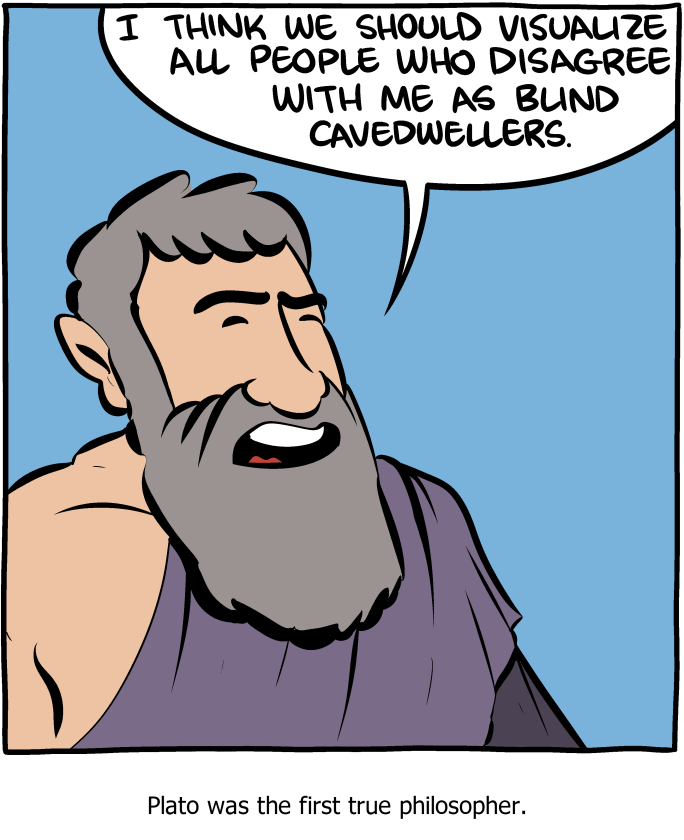
Controlling the Narrative: How Plato combats the Sophists.

"If fighting is sure to result in victory, then you must fight! Sun Tzu said that."

-Team Fortress 2's Jane "The Soldier" Doe.

In the year of 380 B.C.E. Plato found himself at odds with the rhetorical super power of ancient Greece: the Sophists. These radical philosophers had dangerous fringe beliefs such as "our view of reality is limited by the means with which we capable of perceiving it and thus is inherently flawed" or "democracy is a pretty cool system of government". He knew that both these things could only be described as "pure sophistry" and had to be stopped. But how does one take on people as influential as the Sophists? The answer is simple.


[source]

That's right! Plato constructed his famous dialogues in which he pits his OC*, Socrates, against hollow, straw versions of well known Sophists. 

*Evidence suggests that Socrates was not an OC and, instead, was a real person.

Because Plato is the sole author of these works, he is fully in control of how the objects of his ridicule act, what they say, and what they do. Does he use this opportunity to show how high tier his ethos is? Let his readers know that his philosophy could beat the Sophists fair and square? Nah. Instead, Plato forces the Sophists into contrived situations in which they are forbidden from using the full extent of their rhetorical prowess. Why would he want to paint his rhetorical and political opponents as ill tempered sin obsessed fools who can't tell when they are being entrapped? Is it to:

A.) Spread the word to the [white men born in Athens] that the Sophists aren't all that

B.) Play on the fears and preconceived notions of his fellow elitists to convince them that the Sophists represent an existential threat to their continued existence and should be eliminated to further advance their political goals

C.) Express his anger that these people he believes to be fools are held in such high regard

D.) make a joke and be funny, haha


If you guessed B, cool. That's what I would guess too. We can't really know for sure, death of the author and all that. What I'm trying to get at here is that the only opposition the Sophists could give to Socrates is what Plato allowed them to give. Plato has incredible control over our view of the Sophist's because his works are much of the surviving literature on the subject. And the ability to control the media, the conversation, and the narrative, is one of the most potent abilities any rhetor person can have. 

Monday, September 7, 2020

Silko and Storytelling: Stories as Rhetoric

Our reading for this upcoming week reminded me of the Cultural Rhetorics class I took with Dr. Allison Hitt last semester. In the class, we talked a lot about storytelling—particularly in the context of indigenous people and other groups impacted by colonialism—as a valid rhetorical practice.

As Americans, we may think of stories as moral lessons for young children. On the contrary, in Language and Literature from a Pueblo Indian Perspective, Leslie Marmon Silko clarifies that stories are not just for children, but defines them as “something that comes out of an experience and an understanding of that original view of creation—that we are all part of a whole” (3). Though Western ideology loves to disregard personal anecdotes and feelings in favor of logic and facts, this Silko quote illustrates the truth of stories: they implicate more than the individual. As history repeats itself, so do stories. They are universal.

Storytelling is also “decolonial” in that legitimizes a practice which colonialism—with its emphasis on logic and other Eurocentric ideologies—has historically delegitimized. Through storytelling, indigenous people (and other colonized groups) claim their rightful sovereignty over their languages and cultural/rhetorical practices.

For white people like myself, I think stories have a different function. As West Chester University of Pennsylvania instructor Timothy Dougherty explains in Knowing Y(Our) Story: Practicing Decolonial Rhetorical History, “we must learn our own people’s stories of how they’ve come to be in a place, and of how they’ve lived in that place, in order to walk a path of accountability and solidarity”. In other words, we cannot be good, progressive allies without knowing the “meaner events” in our family histories. Dougherty’s piece details how he sought out the unsavory history of his Irish heritage, which eventually revealed that—though Irish people were once subject to racist, anti-immigrant sentiment in America—they “became white” by aligning themselves with white supremacist, genocidal Manifest Destiny ideology. He stresses that this is important because willful ignorance and “collective silence” from white people is a rhetoric of its own, and one which is complicit in colonialism and white supremacy. He states, “even the ugliest stories are instructive for us”.

I think this aligns with Silko’s assertion that “it is very important that one keep track of all these stories -both positive and not so positive about one's own family and other families” (4). The purpose of knowing and sharing these ugly stories is not “malicious”, but so that we can be better, more accountable people and allies.


To the Ancient Egyptians, Silence Was Golden. Maybe We Can Learn from Them

Oftentimes the discussion of contemporary rhetoric turns to talk of unethical persuasion, crooked politicians, advertisements, or arguments. These days, it's near impossible to see media with people interacting peacefully, especially if they disagree with each other. The overwhelming presence of yelling in our TV-scape made one pillar of ancient Egyptian rhetoric poignant to me: silence.


The first of several canons utilized in ancient Egyptian rhetoric, silence serves a few purposes. Firstly it allows a rhetor to keep their own composure while their adversary pokes holes in their stance. More importantly to our modern landscape, silence can highlight the idea of listening. Listening to your opponent's argument gives you time to consider your own, and maybe just give thought to their points. Let's take a look at a few modern examples of people who could have benefited from utilizing the canon of silence.


In this scene from reality TV show Dance Moms, we can see a group of mothers screaming over each other over their individual perceptions of the truth. These stars could have benefited from silence as it would have allowed a clearer message to be conveyed rather than dissolving into an angry argument.


In this compilation from a 2016 presidential debate between Donald Trump and Hillary Clinton, viewers see all the time a candidate was interrupted. These speakers could have utilized silence to build their own credibility while their opposition damaged their own.


After examining the lack of silence in these examples, it's time to accept that maybe we should take a page from ancient Egypt's book. If we opened our ears as much as our mouths, the world would be a much better place to communicate.

Monday, August 31, 2020

Talk Like an (Ancient) Egyptian

 So, the concepts of Egyptian rhetoric really stuck out to me this week. Particularly, the canon of truthfulness was striking, especially in conjunction with the ideas of post-truth that we thought through last week.

Egyptian rhetoric values truthfulness greatly, and Fox writes that it is definitely the most important of the five canons. It is considered the ultimate because fact alone should be enough to persuade audiences. Telling the truth gives you the greatest ethos. Post-truth, though, doesn't value reliable information, and we seem to live in a nation that operates largely under the post-truth umbrella. 

To make the ancient Egyptian rhetoricians proud, I want to illustrate these points with examples, since that's a major way that they showed how rhetoric functions.

We saw this in the Rudy Giuliani video from last week, and we see it on a daily basis from our country's so-called "leader." In the midst of the coronavirus pandemic, we see how facts are twisted and manipulated, not given full understanding. People suddenly seem to think that the 94% of people with underlying conditions that died from COVID-19 didn't actually die from the virus. Check out Hank Green's TikTok about it (excuse the language): https://www.tiktok.com/@hankgreen1/video/6867210198168243461?_d=secCgsIARCbDRgBIAIoARI%2BCjy4PmnU61iMvmUlpb2G8J0xhWh%2BDZBJ%2BV4ESPU0flXtyC8MKM9NAR8FjNohsBDQdLXAn1%2FqmfYYeD%2FcQnsaAA%3D%3D&language=en&preview_pb=0&share_item_id=6867210198168243461&timestamp=1598930988&tt_from=copy&u_code=dab69jh25gm937&user_id=6782366172396323845&utm_campaign=client_share&utm_medium=ios&utm_source=copy&source=h5_m

Another important aspect of ancient Egyptian rhetoric is how they do not differentiate between public speaking and personal conversation. This seems like a practice that would be useful to adopt in the United States. Elected officials need to be held to a higher standard. Our politicians shouldn't be able to brush off talk of assaulting women with some half-baked excuse about "locker room talk." They can though, and they do.

While ancient Egyptian rhetoric is severely lacking, we are seeing plenty of ancient Aztec and Greek traditions. Aztec rhetoric values authoritative speaking highly. The President has built his following off of this: he is brash, rude, politically incorrect, and unafraid to say racist, sexist, homophobic, xenophobic, misogynistic things. He says them with such a total disregard for other people, and he comes across so aggressively that some people respect him for it. They see the authoritarian attitude and they hear the "law and order" preaching, and they go with it. The ancient Aztec rhetoric is effective for them.

For others, the Greek rhetorical aspects are the most effective. Herrick writes that "Greek orators were characteristically quarrelsome and emotional, inclined to bitter personal attacks..." We can see this again and again through Donald Trump's attacks on people via Twitter, in press briefings, and in interviews. He is particularly fond of giving people nicknames to try and belittle them or tarnish their reputation (like Sleepy Joe, Crooked Hillary, Pocahontas... the list goes on). But Herrick continues, and so does Trump: "... [they were] highly resentful of such attacks on themselves, but tolerant of verbal fights by others."

Trump cries about "fake news" every time he gets called out on being wrong. He makes wild claims about the liberal media being totally against him. He refuses to accept that he is wrong. And in terms of tolerance, he seems to lean more towards the tolerance of white supremacists and domestic terrorists. It's not just verbal fights he supports--it's physical violence, too. It ties back to the firm "law and order" image he tries to project. We saw it when he ordered troops to Portland. We saw it when he didn't condemn Kyle Rittenhouse for shooting 3 people and killing 2 in Kenosha, WI. We saw it in his holding children in cages at the border. We saw it in his administration lifting the moratorium on the death penalty.

Realistically, too, we can see where feminist rhetorics ties into this, and why it's so important. The nation is being run in the old, male, Western tradition. And while that tradition has its time and place, now does not seem to be the time. Our country is crumbling. Division grows deeper every day. Now more than ever, we need a leader who behaves rhetorically in a feminist way. We need someone who is multiculturally competent. The old stuff isn't working anymore (and arguably, it was never working for large portions of the population), and it's time for something new.

Sunday, August 30, 2020

“Miss, for a Dollar, Name a Woman!”


Since it is the beginning of the semester, I thought it might be nice to start my post off with some humor before digging into more serious stuff. So, the title of this blog post is based upon the iconic Billy on the Street moment in which Billy Eichner asks a random person to name a woman—any woman—for a dollar, and they hilariously struggle to respond. This moment, though not necessarily meant to have a bigger meaning, can nonetheless be used to symbolize the way women have been forgotten all throughout academia’s history, leading to the present day in which women still fight to be heard. This is of course true in the field of rhetoric, just as we read in Herrick’s book. As such, I made a low-quality meme just for our class. Enjoy:


   That being said, it is of course not just women as a broad category who have had their voices silenced—people of color (and, especially the intersection of these identities, women of color) have also not been given an equal spot light. Additionally, people with disabilities, working class people, people without access to higher education, and a hundred other types and combinations of identities have been hindered in participating in academic spaces because of the pervasive patriarchal, capitalist, and white-centered culture. So many opinions and theories are missing simply because only very few people have the privilege of contributing to the conversations which build up our widely-accepted theories of rhetoric.

   Thus, it is nice to begin this semester by highlighting some of the knowledge produced by such people. So far, we have briefly touched on feminist rhetoric and rhetoric from countries such as ancient Egypt. These views on rhetoric differ from the commonly accepted theory of western rhetoric by placing emphasis on qualities such as co-creation, respect, and a lack of aggressive persuasion. I think that modern rhetoric could benefit from considering such concepts.

   As I understand it, rhetoric, at least as is commonly used in the US, is heavily based in the act of persuasion. When asked what rhetoric is, the students in my intro to rhetoric course in 2018 responded, “the study of persuasion.” Similarly, when I took a communications class on persuasion in 2019, rhetoric was something we discussed frequently, assuming the two always went hand in hand. Not everyone agrees that rhetoric is or should be inherently persuasive, however; Sally Miller Gearhart wrote in 1979 that persuasion, and by extension everyday rhetoric, is an act of violence, as it forces the viewpoints of the speaker onto the listener. The alternative rhetoric which should be studied and practiced, then, is one which values and nurtures both parties in a co-creation process (Herrik 278-279).

   Ancient Egyptian rhetoric took a similar approach. This conceptualization of rhetoric was not focused solely on the merit of the ideas in the argument, but rather, the speaker’s character and the process by which they shared their thoughts. To them, ethos was “not an adjunct to proof, as it is in Aristotle, but is itself a form of proof” (Fox 16). So, without trustworthiness, a rhetor could not persuade another no matter how great their other forms of proof. This led people to pursue “good timing, restraint, fluency of expression and above all truthfulness” (16).

   Though these two views of rhetoric are from different places and times, they both bring valuable considerations to modern rhetoric. For example, from feminists such as Gearhart, speakers can learn better how to communicate in ways which are more welcoming and respectful. This could be beneficial for the masses because a greater culture of empathy (which Gearhart may call a culture of femininity—I personally don’t want to gender characteristics like empathy here, though) could form. In such a culture, the shouting matches we see on TV in the news could become calm discussions focused on finding a compromise rather than picking a side. This could completely change many people’s perceptions of politics and debate, and in doing so, change how every day people communicate with one another.

   From the ancient Egyptian thinkers, we can learn more about our own responsibilities as speakers; for example, how we might build up our characters first, and attempt to persuade others only once we are confident that we are wise enough to responsibly do so? If more people turned inward before speaking, perhaps there would be less fake news and other modern-day problems which cause conflict in our collective pursuit of identifying right and wrong. Thus, both of these forms of rhetoric could, at least in my opinion, can greatly improve how we operate as communicators today, both in the media and in personal conversations.

What other ways might modern rhetoric be improved by viewing opinions outside widely accepted theories? I did not really mention any of the other countries we read about, so does anyone have any thoughts of how they might apply those theories of rhetoric? 

References:

Herrick, James A. The History and Theory of Rhetoric: an Introduction. Routledge, 2018.

Fox, Michael V. Rhetorica: A Journal of the History of Rhetoric , Vol. 1, No. 1 (Spring 1983), pp. 9-22

St. Augustine and How Humans are Inherently Flawed

            Ok so, Christianity is super old, right? So is rhetoric, and the church has been using rhetoric for a very long time. Look at th...